
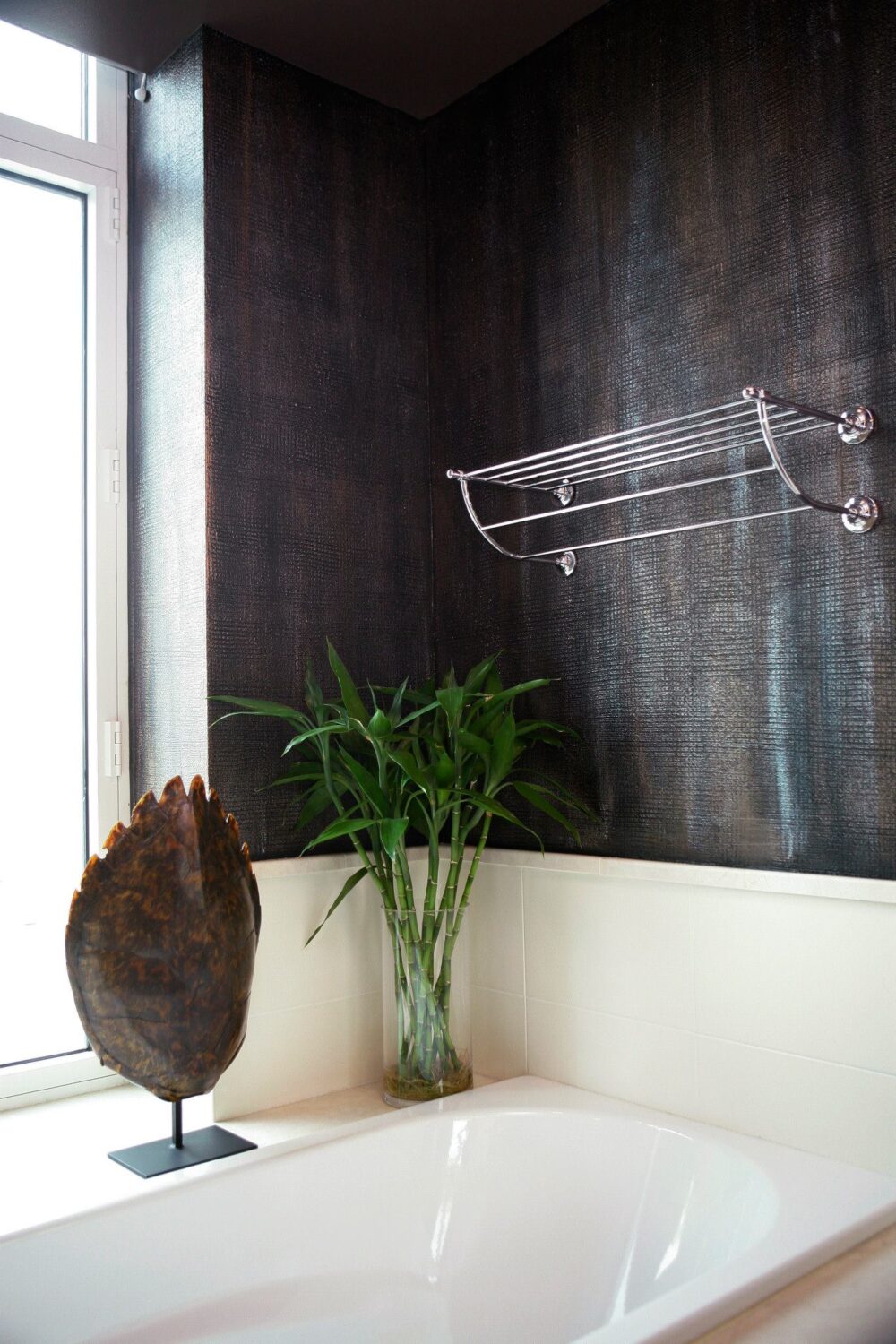
Roman Clay vs Venetian Plaster is a common comparison for homeowners and designers who want walls with warmth, movement, and a more custom feel than paint. Both finishes can create beautiful, tactile interiors, but they are not the same. Roman Clay is often the softer, more casual option. Venetian plaster is typically the more refined, durable, and architectural choice.
If you are choosing a finish for a high-end home, NYC apartment, powder room, stairwell, or feature wall, the right answer depends on how polished you want the space to feel, how much depth you want in the wall, and whether you are looking for a DIY-friendly treatment or a true artisan finish.
Quick Comparison: Roman Clay vs Venetian Plaster
| Feature | Roman Clay | Venetian Plaster |
| Overall look | Soft, matte, plaster-like | Layered, dimensional, stone-like |
| Best for | Casual interiors, organic modern walls, lower-sheen spaces | Luxury walls, ceilings, stairwells, feature walls |
| Application | Often applied with a putty knife or trowel | Hand-applied in multiple layers by a skilled artisan |
| Sheen | Mostly matte | Matte, satin, polished, or softly reflective |
| Depth | Subtle surface movement | Deeper visual movement and light play |
| Durability | Good for decorative interior walls | Stronger luxury finish when installed and sealed correctly |
| Best fit | Relaxed, understated spaces | Refined, custom, high-end interiors |
What Is Roman Clay?
Roman Clay is a plaster-like wall finish that creates a soft, matte surface with subtle movement. Portola Paints describes Roman Clay as a paint and plaster hybrid designed for smooth interior walls, which is part of why it has become popular for organic modern homes and DIY-leaning design projects.
The look is quiet and understated. It works well when you want a room to feel warmer than standard paint, but not as formal or polished as Venetian plaster.
Roman Clay is often used in bedrooms, living rooms, hallways, and accent walls where the goal is a soft, hand-finished feel without dramatic sheen.
What Is Venetian Plaster?
Venetian plaster is a traditional hand-applied plaster finish known for depth, movement, and a stone-like quality. Architectural Digest has covered Venetian plaster’s resurgence in modern interiors, noting its connection to natural materials and warm, lime-plastered surfaces.
Unlike Roman Clay, Venetian plaster is built in layers. The final look depends on the material, the trowel technique, the burnishing, and the way light moves across the wall.
It can be soft and matte, luminous and reflective, or polished for a more dramatic stone-like effect. That flexibility is one reason Venetian plaster is often the better fit for luxury interiors.
The Biggest Difference Is Depth
Roman Clay gives you a soft, plaster-inspired look.
Venetian plaster gives you a true dimensional finish.
That may sound subtle, but in person, it makes a big difference. Roman Clay tends to sit closer to the surface, almost like a more elevated version of matte paint. Venetian plaster feels more integrated into the architecture. It has more movement, more light response, and more of the “finished wall as art” quality Decorfin clients are usually looking for.
When Roman Clay Makes Sense
Roman Clay can be a good choice when the goal is casual texture. It is especially popular in spaces where the overall design is relaxed, warm, and understated.
Choose Roman Clay if you want:
- A soft matte finish
- A more casual plaster-like wall
- Subtle movement without shine
- A lower-commitment decorative finish
- An organic modern, Japandi, or relaxed minimalist look
Roman Clay is beautiful in the right space. It just usually does not deliver the same level of depth, polish, or long-term luxury as Venetian plaster.
When Venetian Plaster Is the Better Choice
Venetian plaster is usually the stronger choice when the wall is meant to be a design feature, not just a textured backdrop.
Choose Venetian plaster if you want:
- A high-end, custom wall finish
- More control over texture, sheen, and movement
- A finish that changes beautifully with natural and accent lighting
- A more durable artisan surface when installed properly
- A wall that feels architectural, not decorative
This is where Decorfin’s craftsmanship matters. Venetian plaster is not just a product. It is a process. The final result depends on the skill of the applicator and the way the finish is tailored to the room.
Where Each Finish Works Best
| Space | Better Choice | Why |
| Bedroom accent wall | Roman Clay or Venetian plaster | Roman Clay feels soft, Venetian plaster feels more refined |
| Living room feature wall | Venetian plaster | Adds more depth and long-term visual impact |
| Powder room | Venetian plaster | Creates a stronger jewel-box effect |
| Stairwell | Venetian plaster | Light movement makes the wall more dramatic |
| Casual hallway | Roman Clay | Softens the space without feeling formal |
| Ceiling detail | Venetian plaster | Feels more architectural and elevated |
| Luxury NYC interior | Venetian plaster | More polished, custom, and timeless |
Design Feel: Casual vs Refined
Roman Clay has a relaxed, chalky elegance. It is ideal when the design brief calls for softness and restraint.
Venetian plaster feels more refined. It can still be quiet, but it carries more sophistication. A matte Venetian plaster wall can feel calm and understated, while a polished or softly burnished finish can bring depth and light into the room.
If the space is meant to feel high-end, Venetian plaster usually gives you more to work with.
Durability and Maintenance
For decorative interior walls, Roman Clay can perform well when applied correctly. It is best suited for smooth interior surfaces and areas where it will not take heavy abuse.
Venetian plaster is often the better option when durability and finish longevity are priorities. When properly installed and sealed, it can hold up beautifully in living spaces, stairwells, powder rooms, and statement areas.
As with any plaster finish, surface preparation matters. A rushed application or poor substrate can compromise either finish.
The Bottom Line
Roman Clay is a beautiful choice when you want a soft, matte, plaster-like wall with a relaxed feel.
Venetian plaster is the better choice when you want depth, craftsmanship, durability, and a more elevated finish. For Decorfin clients, that difference matters. The goal is not just to add texture. It is to create a wall that feels intentional, timeless, and tailored to the space.
Bring the Right Finish Into Your Home
If you are deciding between Roman Clay and Venetian plaster, the best next step is to see samples in person. Light, scale, color, and sheen can completely change how a finish reads in your home.
Schedule a consultation with Decorfin to compare finishes, review samples, and choose a wall treatment that fits your space, your style, and the level of craftsmanship you want.
FAQs About Roman Clay vs Venetian Plaster
Is Roman Clay the same as Venetian plaster?
No. Roman Clay is a plaster-like paint hybrid with a soft matte finish. Venetian plaster is a layered artisan plaster finish that can create more depth, sheen, and stone-like movement.
Which looks more luxurious?
Venetian plaster usually looks more luxurious because it has more depth, customization, and light movement. Roman Clay is softer and more casual.
Is Roman Clay easier to apply?
In many cases, yes. Roman Clay is often seen as more approachable than traditional Venetian plaster. Venetian plaster typically requires more technique and professional craftsmanship.
Can Roman Clay be used in bathrooms?
Roman Clay is generally best for smooth interior walls, not direct wet areas. For bathrooms, the right finish depends on moisture exposure, sealing, and the specific wall location.
Is Venetian plaster worth the investment?
Yes, if you want a more permanent, refined, and custom wall finish. Venetian plaster is especially worth it for feature walls, powder rooms, stairwells, ceilings, and luxury interiors.