
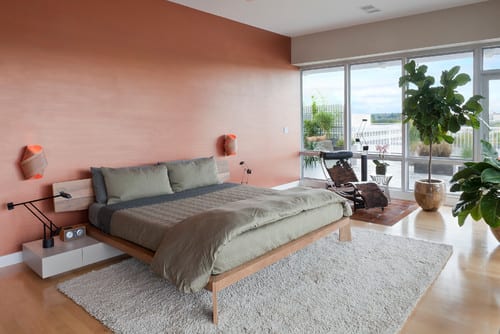
The plaster walls vs drywall question is mostly about how a wall is built. Traditional plaster walls are troweled on in wet coats over lath, while drywall is a factory-made gypsum panel fastened to the framing, taped and painted. Decorative plaster is a third thing: a hand-applied finish that changes how a wall looks and feels. Our Venetian plaster finishes sit in that third category, so the real choice is what surface you have and what finish you want on top.
Wall Assembly vs. Decorative Finish: What’s the Difference?
Wall assembly is the structure. Decorative finish is the surface you see and touch.
A traditional plaster wall is built in layers. According to the National Park Service, historic three-coat plaster used a scratch coat and a brown coat, each about 3/8 inch thick, followed by a finish coat only about 1/8 inch thick. Those coats went over wood lath, metal lath, or later, rock lath, a gypsum panel with a paper facing.
Drywall skips the wet base coats. The Gypsum Association describes gypsum board as a panel with a core made primarily of gypsum and paper surfacing. Panels go up, the joints are taped and finished, and the wall is ready for paint.
A decorative plaster finish like Venetian plaster is neither of these. It’s a hand-troweled surface applied over a wall that’s already in place.
Texture and Appearance: How Plaster Versus Drywall Walls Look
Painted drywall reads flat and even. Plaster reads as depth. Paint covers a surface in one uniform color, so light lands on it evenly. Hand-applied plaster builds up in layers, and each pass of the trowel leaves subtle movement that catches light differently through the day.
The same National Park Service brief notes that a modern veneer plaster system, a thin plaster coat over special gypsum panels, looks more like traditional plaster than drywall once it’s troweled or textured.
Here’s how the main options tend to look on the wall:
| Surface | How it’s made | How it tends to look |
|---|---|---|
| Painted drywall | Gypsum panels, taped joints, paint | Flat, even color |
| Traditional plaster wall | Base coats over lath plus a thin finish coat | Smooth or textured, with subtle contours |
| Venus finish | Hand-applied Venetian plaster | Smooth and glossy with rich pigmentation |
| Notti finish | Hand-applied Venetian plaster | Matte and silvery with a velvet look |
| Fondus finish | Hand-applied plaster texture | Rustic, with earthy tones |
Preparation and Project Scope: What Changes the Job
Project scope depends on the wall you already have, not only the finish you pick. Before any plaster goes on, our installers look at the substrate, its condition, and how much heat or moisture the room sees. Those details decide whether the surface needs repairs, a primer, or a different system altogether.
There isn’t one preparation method that works for every wall. A few questions we sort out on site:
- Is the wall drywall, original plaster, masonry, or a mix?
- Are there cracks, patches, or loose areas to fix first?
- Is the space near a shower, cooktop, or fireplace?
- Which finish system is compatible with that surface?
For bathrooms and showers, ask whether our Tadelakt plaster for bathrooms suits the space better. On installation day, our team protects your furniture and prepares the room before work begins, then leaves the area clean when the job is done.
Where a Decorative Plaster Finish Fits in Your Home
A decorative plaster finish fits wherever you want the wall to be part of the design instead of a backdrop. Through our interior design services, we’ve applied Venetian finishes to walls, ceilings, fireplaces, and kitchen backsplashes, and Tadelakt inside showers. Each space still gets its own surface and exposure check first.
You also don’t have to pick plaster or drywall for the whole house. Structure and finish are separate decisions, so a room framed in drywall can still get a hand-troweled finish where your installer confirms the surface is suitable.
If you’re curious how standard plaster compares with an artisan finish, our post on ordinary plaster and quality Venetian plaster walks through the differences. To see finished rooms, browse the Decorfin project portfolio, which includes private residences and commercial spaces around the New York area.
Choose the Right Finish in the Plaster Walls vs. Drywall Decision
The plaster walls vs drywall question comes down to structure versus finish. Your wall assembly decides how the room is built. Your finish decides how it looks and feels every day. Bring photos of your space to a consultation, and we’ll look at the surface, talk through texture and sheen, and create a custom sample so you can see the finish before installation. Book a Decorfin finish consultation and request project samples
Plaster Walls vs. Drywall FAQs
Is plaster better than drywall?
Neither is better for every home. Plaster walls are built in wet coats and have a hand-finished character. Drywall skips the wet base coats, so it goes up faster. If you want the plaster look, a decorative finish may be an option over a sound, compatible wall.
Can you put Venetian plaster over drywall?
It depends on the wall. Our installers check the drywall’s condition, the room’s heat and moisture exposure, and finish compatibility before recommending a system.